Four sustainable paths.
Zero greenwashing.
Recyclable mono-material laminates. Industrial-compostable PLA + NatureFlex stacks. FSC paper-based cartons. Plastic-reduction redesigns. We'll quote each path with the honest barrier trade-off — and tell you which one makes sense for your market.
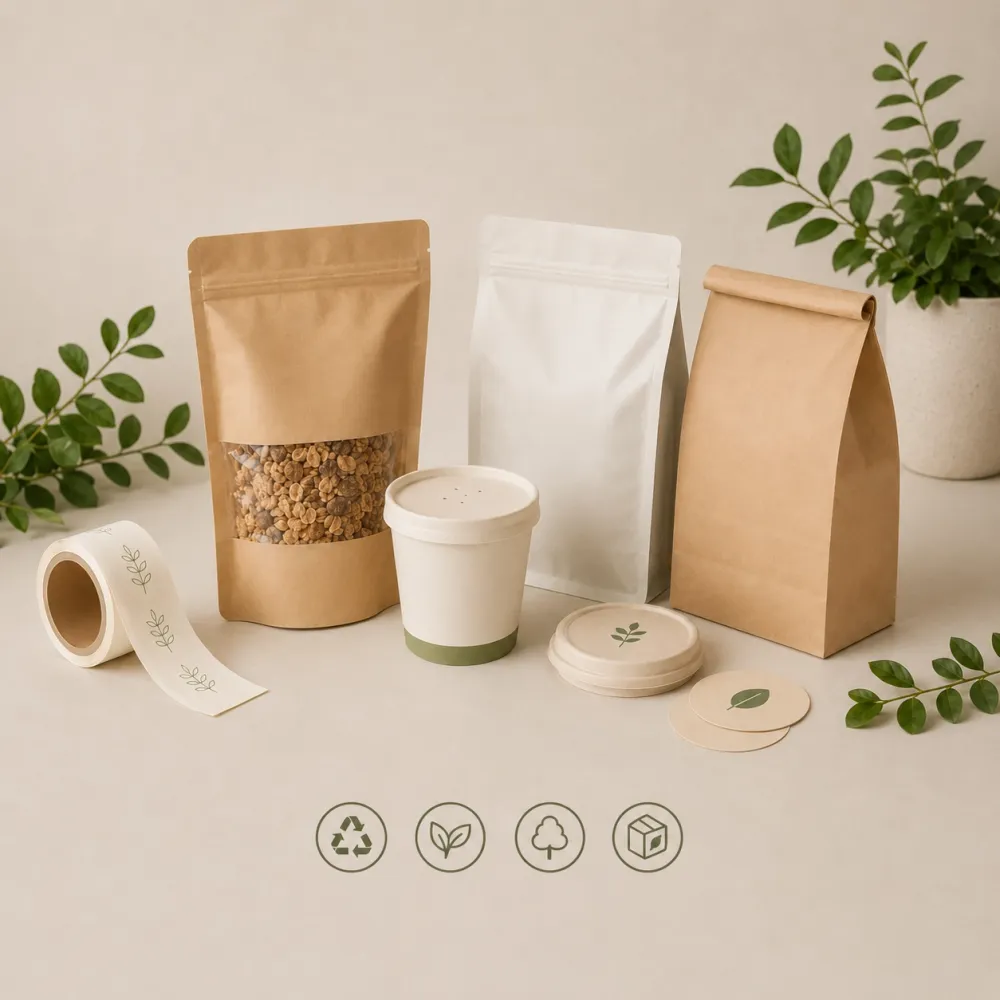
Pick the one that matches your buyer's recycling infrastructure.
Recyclable mono-material
Single-polymer laminates (mono-PE / mono-PP). Compatible with store drop-off LDPE bins per APR guidelines. Best when curbside recycling is your buyer's expectation.
Barrier ~30% of full-foil — limits shelf life to 9 mo on whole-bean coffee, 12 mo on chocolate.
Industrial compostable
PLA + NatureFlex + paper laminates certified BPI / TÜV OK Compost INDUSTRIAL / DIN EN 13432. Decomposes in 90 days at municipal composting facilities (~55°C).
Not home-compostable. Needs access to industrial composter (limited in most US markets, common in EU).
FSC-paper based
Kraft paper outer + minimal plastic inner liner (PLA or thin PE). FSC chain-of-custody documented. Best aesthetic-sustainability balance for coffee, chocolate, gift boxes.
Paper picks up moisture in humid climates. Best with PLA inner for short-shelf-life specialty foods.
Reduced-plastic / minimum-pack
Thinner gauge films, optimized dieline (less trim waste), right-sized cartons. Same materials, but ~20–35% less plastic per unit shipped.
No certification badge — but measurable lifecycle reduction. Often the highest-ROI sustainability move.
Six options. Each with barrier, shelf life, and cost stated honestly.
| Stack | End-of-life | Certification | Barrier | Shelf life | Cost |
|---|---|---|---|---|---|
| Mono-PE laminate | Curbside / drop-off recycle | APR-recognized (US) | OTR ~12 · WVTR ~3 | 9 mo coffee · 12 mo chocolate | +8% vs PET/PE |
| Mono-PP laminate | Drop-off recycle (limited) | APR-recognized (US) | OTR ~8 · WVTR ~2 | 10 mo coffee · 14 mo chocolate | +12% vs PET/PE |
| Kraft + PLA + PE | Industrial compost (EU) | BPI / TÜV OK INDUSTRIAL | OTR ~6 · WVTR ~5 | 8 mo coffee · 10 mo chocolate | +18% vs PET/PE |
| PLA + NatureFlex | Industrial compost | BPI / TÜV OK INDUSTRIAL / DIN | OTR ~15 · WVTR ~8 | 6 mo coffee · 8 mo chocolate | +30% vs PET/PE |
| FSC paper + PE liner | Paper recycle (most municipalities) | FSC Mixed / 100% | OTR ~10 · WVTR ~6 | 8 mo · 10 mo | +15% vs PET/PE |
| Recycled paper + soy ink | Paper recycle | FSC Recycled · Soy-ink | Mech protection only | N/A (cartons, dry food) | +10% vs virgin FBB |
Six certifier programs. Each tied to a specific stack.
BPI Certified Compostable
Biodegradable Products Institute, North American compost certification. Required for many US municipal compost programs.
TÜV OK Compost INDUSTRIAL
European industrial composting per EN 13432. Required for German, French, Italian retail.
DIN-Geprüft Industrial Compostable
German industrial compostability — required for German retail; complements TÜV OK.
FSC Mixed / 100% / Recycled
Forest Stewardship Council chain-of-custody. Required by Aldi, Lidl, Whole Foods on all paper packaging.
APR Design for Recyclability
Association of Plastic Recyclers — North American recyclable mono-material design guidelines.
RecyClass Class A-F
European recyclability scoring — Class A is fully recyclable, F is non-recyclable. We target Class A or B on mono-stacks.
From conventional to certified — four steps.
Sustainability brief
Tell us your goal: 'curbside recyclable', 'industrial compostable', 'FSC paper', or 'plastic reduction'. Tell us your shelf-life floor — that drives the trade-off.
Stack proposal + barrier math
We propose 2–3 stack options with honest barrier comparison vs. your current conventional stack. Shelf-life expectations stated in writing.
Certification path locked
We confirm which certification body (BPI / TÜV / FSC / APR) will sign off, and what lead time + cost the cert adds.
Pilot run + lab validation
First production run sent to certifier for verification. Once passed, certifier logo is licensed for your packaging artwork.
The honest questions buyers ask about sustainable packaging.
Is 'eco-friendly packaging' actually better for the planet?
Honest answer: it depends. A PLA pouch in a region without industrial composting becomes landfill — and PLA in landfill releases methane, which is worse than a PET pouch sitting inert. Recyclable mono-PE is genuinely better in regions with store-drop-off infrastructure. FSC paper is genuinely better than non-FSC paper, every time. Plastic reduction (thinner gauge, less material per unit) is unambiguously better. We'll talk through your specific market's infrastructure before recommending a path.
What does 'compostable' actually mean?
It means 'industrial compostable per BPI / TÜV OK Compost INDUSTRIAL' — decomposes within 90 days at a municipal composter operating at 55°C. It does NOT mean 'home compostable' (different cert, much harder to achieve) and it does NOT mean 'biodegradable' (biodegradable has no time limit and can take centuries). We never let clients call industrial-compostable packaging 'home compostable' — it's a regulatory landmine.
Why does eco-friendly cost more?
Three reasons: (1) the materials themselves cost 1.5–3× conventional — PLA, NatureFlex, FSC paper are all niche supply chains; (2) certification adds a one-time cost and per-stack annual revalidation; (3) MOQ is higher on niche stocks because suppliers run them less frequently. Our +8% to +30% premiums account for all three. Plastic reduction (thinner gauge, smaller cartons) is the exception — it often saves money.
Can compostable packaging hold whole-bean coffee for 12 months?
Generally no. A standard PLA + NatureFlex compostable stack maxes out around 6 months on whole-bean roast — the barrier isn't there. For 12+ months you need either kraft + PLA + a thin metallized layer (which loses compostable cert), or recyclable mono-PP, or full-foil (not eco). We tell clients this upfront before they commit, because shipping 12-mo SKUs in 6-mo packaging is a recall waiting to happen.
Does FSC paper work for wet or oily food?
Not on its own — paper alone wicks oil and absorbs moisture in 2–4 weeks. We pair FSC kraft with a PLA inner coating (still industrial-compostable) or a thin PE liner (FSC paper recyclable in most municipalities) depending on what you're packing. For foil-lined coffee bags and most chocolate wraps, FSC + PLA is the sweet spot.
How do I avoid greenwashing?
Three rules: (1) Only use certifier logos for the specific stack that has the cert — don't put a BPI logo on a non-compostable carton just because the bag inside is compostable. (2) State the end-of-life clearly on the package — 'industrial compostable', 'store drop-off recyclable', 'curbside recyclable'. Don't just say 'eco-friendly'. (3) Make the recycling instruction specific to the buyer's region. We help artwork-review for these before we print.