Migration-tested.
Documented.
Audit-ready.
Food-safe packaging compliant with FDA 21 CFR, EU 10/2011 + 1935/2004, LFGB, GB 4806, and Japan's positive-list regime. Every stack migration-tested at an accredited lab. Every shipment ships with seven compliance documents already in the file.
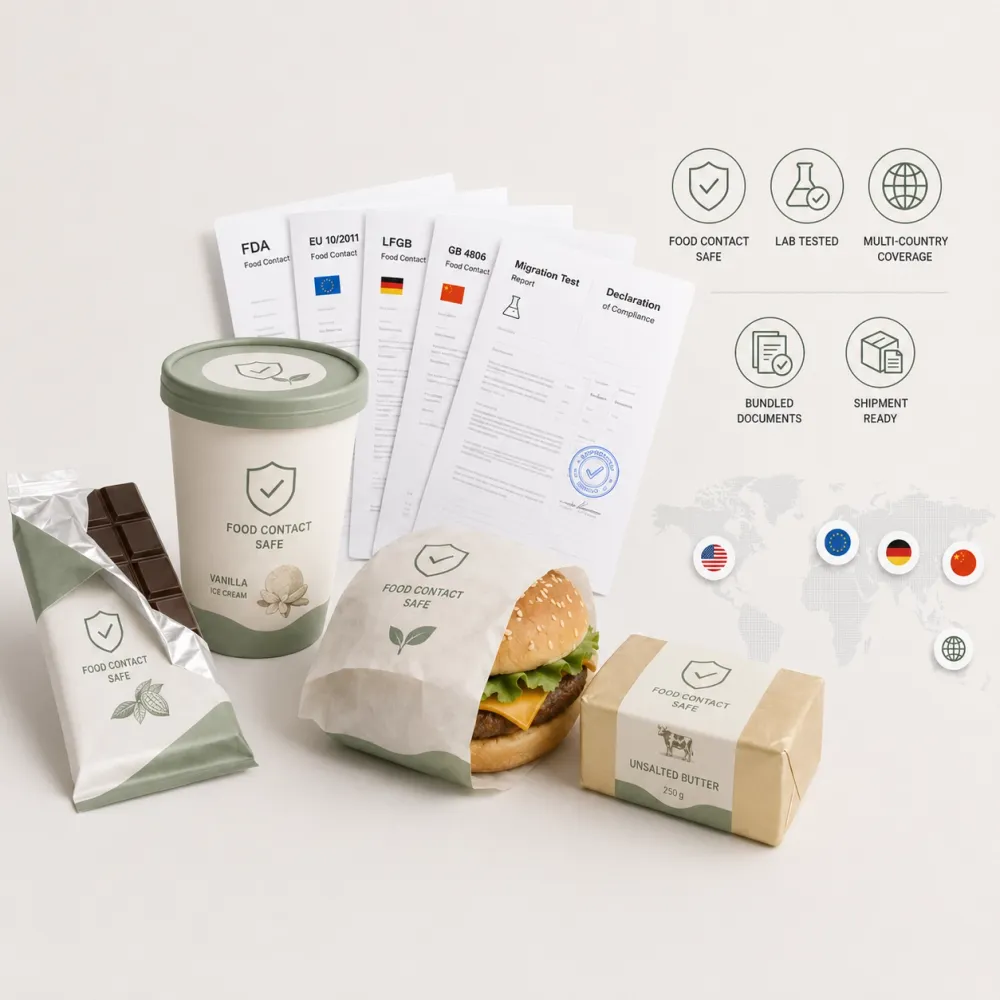
Eight jurisdictions covered. One compliance team.
| Reg code | Region | What it covers |
|---|---|---|
| FDA 21 CFR 175–178 | United States | Indirect food contact materials (films, adhesives, coatings, colorants) for all food types. |
| EU 10/2011 | European Union | Plastics in contact with food. Specific migration limits per substance. Mandatory on all flexible packaging. |
| EU 1935/2004 | European Union | Framework regulation — overall safety obligation for all food contact materials. |
| LFGB §30/§31 | Germany / EU import | German Federal Food Act. Mandatory for German retail and most EU department stores. |
| GB 4806 | China | Chinese national standard for food contact materials. Mandatory for Chinese-domestic SKUs. |
| GB 9685 | China | Permitted additives in food contact materials. Migration limits per substance. |
| FSANZ Std 1.4 | Australia / New Zealand | Food Standards Australia New Zealand — contaminants and natural toxicants. |
| JFSL §370 | Japan | Japanese Food Sanitation Law — positive list for plastics, effective June 2025. |
Six food types. Six test protocols. The right stack for your fill.
Aqueous (water-based)
e.g., Tea, broth, juice
10% ethanol, 3% acetic acid · 10 days @ 40°C
Acidic (pH < 4.5)
e.g., Fruit, vinegar, wine gummies
3% acetic acid · 10 days @ 40°C
Alcoholic
e.g., Alcohol-filled chocolate
10% / 50% / 95% ethanol · escalating ladder
Fatty (lipophilic)
e.g., Chocolate, nuts, oily snacks
Olive oil · iso-octane substitute · 10 days @ 40°C
Dry food
e.g., Coffee beans, dry powder
Tenax-substitute · 10 days @ 40°C
Frozen (–18°C)
e.g., Frozen pastry, ice cream
Low-temp migration · sequential temperature stress
Seven compliance documents. Pre-bundled. No follow-up email needed.
Material Safety Declaration
Per-stack declaration of conformity citing FDA 21 CFR + EU 10/2011, signed by our QC manager and material supplier QA.
Migration test report
Specific Migration Limit (SML) and Overall Migration Limit (OML) test panel from accredited lab (SGS / Intertek / Eurofins).
Material Certificate of Analysis
Per material lot from upstream supplier. Includes thickness, dyne, treatment value, FDA / EU citations.
Heavy metals & SVOC test
Lead, cadmium, chromium VI, mercury, plus restricted SVOCs. Annually revalidated per ink supplier.
Allergen control statement
Plant-wide allergen-control program: gluten-free / nut-free / soy-free production runs available, segregated equipment, swab-validated.
BPA / phthalate declaration
Bisphenol-A free, ortho-phthalate free, PFAS-free declaration for the full material stack including inks and adhesives.
Halal / Kosher (on request)
Halal certification (JAKIM-equivalent) and Kosher (OK / OU) on request. Adds 3–5 days lead time.
Four steps. Built into every quote.
Stack design
We spec a laminate stack matched to your food simulant class. Aqueous foods can run kraft + PLA; fatty foods need PET / Al / PE full-barrier with FDA-cited adhesive.
Pre-production qualification
First production run sent to accredited lab. Specific migration + OML + heavy metals tested. If anything exceeds SML, we re-spec before scaling.
Lot-traceable production
Every roll lot stamped, material COA bound to your order. No cross-batch blending. Retain samples held 24 months per SKU.
Documentation bundle
Seven documents shipped with every PO. Customs-ready, retailer-ready, audit-ready. No follow-up emails to ask for paperwork.
Compliance questions buyers ask in customs and onboarding.
Do I really need both FDA and EU 10/2011 if I only sell in one market?
If you only sell in one market: no. But most growing food brands eventually want optionality — exporting to Europe, listing on Amazon EU, attending Anuga or SIAL. We default to dual FDA + EU compliance because re-tooling a stack later (changing adhesive, switching ink suppliers) adds 6–8 weeks. Cheap insurance.
What's the difference between SML and OML?
Overall Migration Limit (OML) caps total non-volatile substances that can migrate to food — 10 mg/dm² under EU 10/2011 standard conditions. Specific Migration Limit (SML) caps individual restricted substances (e.g., specific phthalates, antimony). A stack must pass both. We test both.
Are your inks food-safe?
Yes. We use low-migration food-contact inks (Siegwerk, Sun Chemical, Flint) on the outer print layer. Inner-print (rare, e.g., embossed foil) uses an even stricter set with food-contact lacquer overlay. Our ink shop is segregated from non-food work to avoid cross-contamination.
Can your packaging contact alcohol or oily chocolate?
Yes — with the right stack. For >20% alcohol (alcohol-filled chocolate, liqueur ganache) we use a PET / Al / PE full-barrier with EVOH-modified PE inner — alcohol migration is much harsher than fat. For oily chocolate (cocoa butter, dairy fat) we use foil-laminated stacks tested per olive-oil simulant. Both stacks have current test reports on file.
Do you handle allergen segregation?
Yes. Our plant runs allergen-control protocols (gluten-free, nut-free, soy-free SKUs use dedicated press lines and dedicated material handling, swab-validated post-run). For severe-allergen-sensitive runs (e.g., infant food contract), we schedule whole-shift cleaning between non-segregated runs and dedicated runs.
What if a test fails post-shipment?
Our retain sample is the reference. If your incoming-inspection lab flags an issue, we run a same-source retest from our retain. If migration is confirmed out-of-spec, the lot is held / recalled at our cost and a corrective-action root-cause report is delivered in 5 working days. We've had three such events in five years; all reconciled to material supplier batch defects, traced to source.